Inclusive Education Key to Kaduna’s Development says SUBEB as Stakeholders Mark 2025 IDPD
By Uangbaoje Alex, Kaduna
Kaduna State marked the 2025 International Day of Persons with Disabilities (IDPD) on Monday with a call for stronger commitment to inclusive education, led by the State Universal Basic Education Board (SUBEB), which declared that no society can attain true progress while excluding persons with disabilities.
Delivering the keynote address, Director of Special Programmes at SUBEB, Mrs. Esther Jibji, said this year’s theme: “Fostering Disability-Inclusive Societies for Advancing Social Progress” speaks directly to Kaduna State’s mission to build an education system where “every child, regardless of ability, has access to quality, equitable and inclusive learning.”
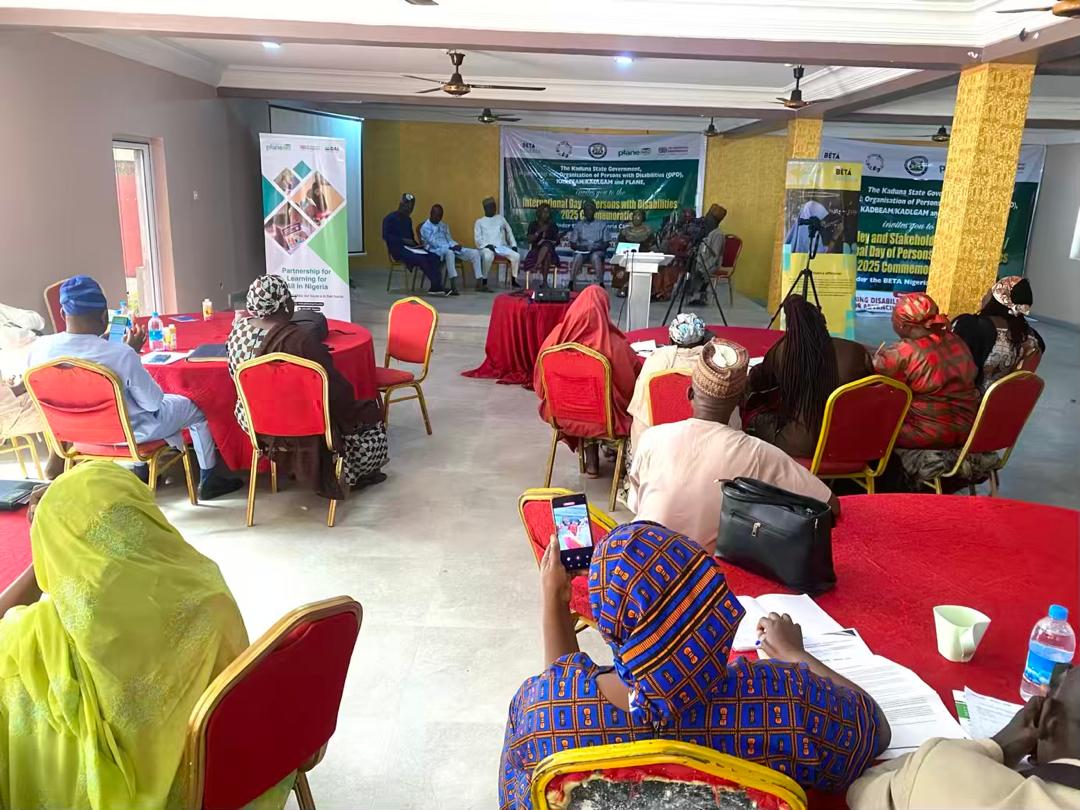
The event was organized by Kaduna State Government in partnership with Organizations of Persons with Disabilities, with support from PLANE through the Better Nigeria Campaign.
Jibji said disability-inclusive education improves academic performance, enhances social skills, prepares learners for economic independence, and breaks physical, social and attitudinal barriers that limit participation.
She stressed that inclusive education is not optional but a fundamental right aligned with global human rights standards and essential for sustainable development.
Highlighting progress made under the PLANE-supported inclusive education programme, Jibji disclosed that Kaduna enrolled 3,177 out-of-school learners with disabilities during the 2025/2026 enrolment drive across 20 LGAs.
She also presented findings from the pilot of the Child Functioning Module (CFM), where 71 of 690 Primary 1 learners were identified with functional difficulties requiring targeted support.
Jibji commended Governor Uba Sani for providing the political will and partnerships that have strengthened inclusive education through improved teacher training, adapted learning environments and policy frameworks.
However, she warned that persistent challenges such as insufficient funding, weak disability data, inadequate early identification, limited assistive technology and low community engagement, continue to slow progress.
She urged deeper collaboration among government, OPDs, CSOs, development partners and the media to build a system where “no child is invisible and no disability goes unnoticed.”
Chairman of the Organization of Persons with Disabilities (OPDs), Rilwani Mohammed, earlier said inclusive education must remain the foundation of Kaduna’s push for disability-inclusive development.
He described the enrolment of children with disabilities into public schools as a moral and developmental imperative, not charity, and praised PLANE for supporting enrolment drives, early identification, teacher training and community sensitisation.
PLANE’s Results and Learning Manager, Musa Jimoh, who represented the State Team Lead, Diana Agabi, said partnerships with government, OPDs and communities have enabled over 3,000 children with disabilities to enter public schools.
He reaffirmed PLANE’s commitment to strengthening early learning interventions, safeguarding systems, teacher capacity and inclusive school environments across Kaduna State.
The Ministry of Education, represented by Mukhtar Maude, Director of Public Schools, pledged continued support for policies that uphold dignity, participation and equal opportunity for learners with disabilities.
He described inclusion as a fundamental right and a prerequisite for sustainable development.
The Kaduna Basic Education Accountability Mechanism (KADBEAM), represented by Mr. Simeon Olatunde, said the event aligns with years of advocacy to ensure disability inclusion at all levels of education across the state.
The Kaduna State Disability Affairs Board, represented by Silas Dogo, applauded PLANE for its consistent backing of disability programmes, including the recent review and implementation retreat in Zaria.
He expressed optimism that the discussions from the IDPD engagement would expand opportunities for persons with disabilities across policymaking and service delivery.
Chairman of the National Association of Proprietors of Private Schools (NAPPS), Busayo Akintunde, assured that over 2,000 private schools in Kaduna remain committed to supporting inclusive education reforms and improving their capacity to serve learners with disabilities.
Stakeholders reaffirmed their commitment to advancing disability inclusion in Kaduna State with the submission that “A society that excludes persons with disabilities can never achieve true progress. But a society that listens, adapts and includes all will always thrive.”